
Project title
Trends in hidden taxa and habitats – understanding the extent and impact of the biodiversity crisis (TrenDIV)
Sub-project
Aquatic Sediments
Project Management
Nancy Mercado Salas
Description
Background
The biodiversity crisis driven by climate and land-use change is one of the most pressing challenges facing societies. Yet even well-studied countries such as Germany lack long-term biodiversity monitoring across taxa and habitats. Current evidence of animal biodiversity loss is largely based on a few taxa, such as birds and dragonflies. These taxa provide an initial insight into biodiversity dynamics. However, it remains unclear whether the observed patterns reflect broader changes in species diversity and vary across habitats, species traits, body sizes and trophic levels. This gap is particularly pronounced for poorly studied groups such as aquatic sediment- and soil-dwelling invertebrates, which account for substantial biomass, are highly diverse and perform key ecosystem functions.
TrenDIV Project
This project will quantify biodiversity trends across under-explored taxa, habitats and ecosystems throughout Germany. We will investigate soil meso- and microfauna, flying insects, marine and freshwater sediment fauna, and the microbiomes associated with these invertebrates. By revisiting historical sites, we will compare historical and contemporary communities. Using standardised sampling, morphological identification, DNA-based methods and metabarcoding, we will assess changes in species richness, biomass, community composition and functional traits. Sampling across agricultural land, forests, meadows, marine and freshwater systems, springs and wells will enable us to identify general biodiversity patterns and extrapolate them across Germany. Overall, the project aims to reveal how hidden biodiversity has changed over the past 25–45 years and assess the functional implications of these changes.
Further information in the news:
“Research project analyses changes in biodiversity since 1960 – and the consequences for groundwater”
TrenDIV Aquatic Fauna Sub-project
Small, hidden aquatic taxa are likely to be particularly vulnerable to anthropogenic stressors due to their specialised ecological requirements and limited distributions; however, their responses to climate change and human impacts remain poorly understood. We will compare data on marine species (North Sea Benthos Survey, 1986) and freshwater specimens (Museum der Natur, Hamburg) from German sediments (Fig. 1) with data from the same sites sampled in 2026 (Video 1).
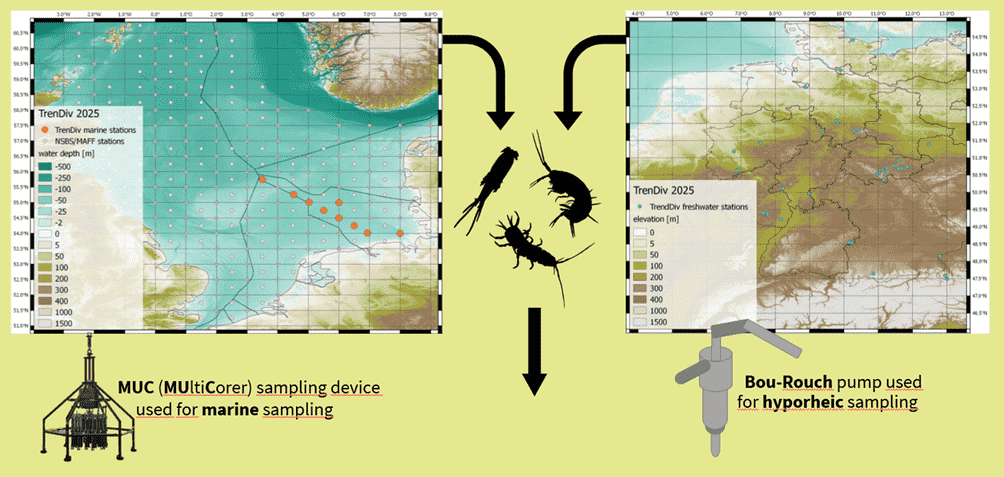
We will examine selected groups of crustaceans (Copepoda, Amphipoda and Isopoda) due to their ecological importance (Videos 2 & 3). To assess and define species and describe entire communities as accurately as possible, the project will employ an integrative species characterisation approach that combines morphological, genetic and functional data. Comparisons with historical data will reveal temporal trends and the potential effects of environmental change on ecosystem functioning and resilience.


