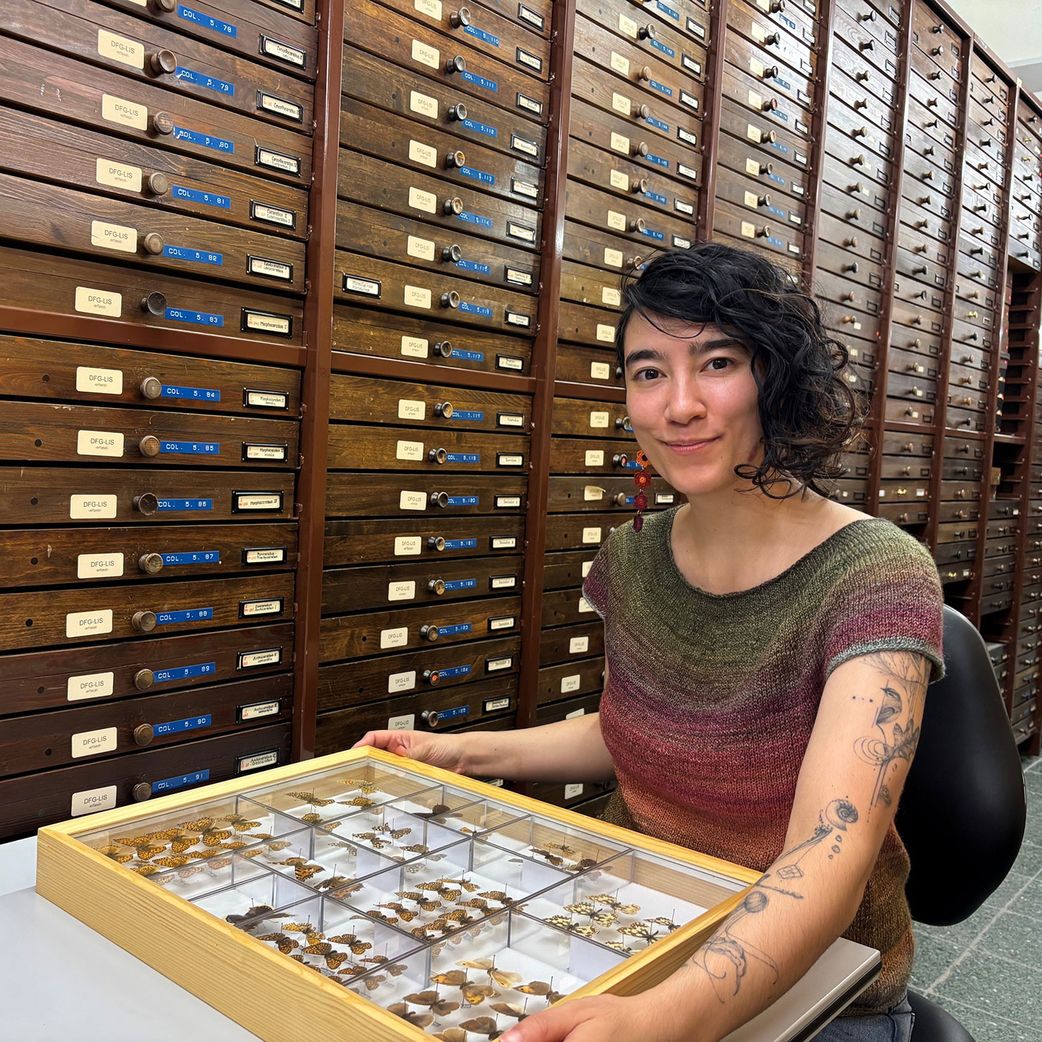
Eileen Nguyen is still amazed whenever she pulls open a drawer in the insect collection. So much beauty and diversity unfolds here, and so many new discoveries too. In our interview, the LIB’s technical assistant explains why she sometimes feels like a detective in her work. Eileen Nguyen is our Face of the LIB for November.
How would you describe your work in three sentences?
Essentially, I work with dead, prepared and preserved insects. I ensure that they are preserved for as long as possible and stored in such a way that we can locate them when required. In addition, we try to make the specimens and the information we have about them accessible to the public and the scientific community – for example, through photographs, scans or by sharing historical data from the labels.
How did you end up in this profession?
I first got a taste of the field during my school work experience at the Natural History Museum in Chemnitz. I prepared butterflies, helped with an exhibition and set up traps in the field. Those were memorable moments.
After school, however, I first studied Japanese Studies and completed my Bachelor’s degree. Towards the end of my studies, I realised I’d prefer to do something more practical. So I ended up working in the zoology department at the Museum of Western Lusatia in Kamenz.
There, I learnt about collection management and taxidermy techniques. Together with my colleagues, I began to rediscover nature, to get out into the countryside, to recognise bird calls and to observe birds. I then realised: this is what I can see myself doing in the future. Eventually, I applied for an apprenticeship as a technical assistant at the Senckenberg Natural History Museum in Frankfurt. There, I realised that I was passionate about it. I particularly enjoyed the practical side of things. During excursions, fieldwork, and whilst collecting, identifying and preparing insects, I knew: I’m on the right track.
A marvel of shapes, colours and sizes
What do you particularly enjoy about your work?
Working in the collection. The insect collection is so vast and diverse. Whenever you open any drawer, you always see something new. The shapes, colours and sizes – it’s got everything. You’re constantly amazed.
I’ve also developed a love for working with older material and researching data. I’ve contributed to several type catalogues, which involved a great deal of literature research – to check whether the specimens match the original descriptions.
It’s detective work. With expedition materials in particular, there are historical find records or names. Then I have to find out: where is that place today? Sometimes I’ve compared historical maps and travel accounts. I really enjoy that, even though it can be frustrating when you don’t get any results.
What advice would you give to young people starting out in their careers?
If you have the chance to try things out, you should make the most of it. It helps you work out: is this really the right thing for me? That’s why I think opportunities like voluntary work or the Federal Voluntary Service are brilliant for getting a taste of different fields.
What does nature mean to you?
I’ve always loved being outdoors since I was a child. But in Kamenz (Saxony), I’ve gained a whole new perspective on nature. I’ve started paying much more attention to it: what’s going on around me? What can I hear?
Nowadays, I walk through nature with a completely different outlook. When my partner Jan-Henrik and I are out and about, we look to see what’s about. We also pay more attention to insects, peer into the bushes, stop and let our gaze wander.
For me, it’s always lovely to open myself up with all my senses and learn something new. When there are lots of birds about again in spring, you find yourself thinking: ‘Who’s singing there?’ Oh yes, that’s the robin.
Are there any particular places that are especially dear to you?
We’re actually always on the lookout for new areas so we can cover as much ground as possible. Naturally, the coast and the sea are obvious choices. There are completely different birds there, which are specific to those areas.
Vietnam is also a special and important place for us, as part of my family lives there. Exploring Vietnam’s natural landscapes is always a very special experience: actually seeing birds, rather than just hearing them, always feels like a particular achievement, whilst insects and spiders are often very much in evidence and can be marvelled at in all their splendour and diversity at almost every turn.
To what extent does your work have social relevance?
We regularly welcome students and visitors and guide them through the collections. This gives us the opportunity to explain why we collect specimens in the first place and how important such collections are for modern science.
Even if an animal is 200 years old, it is significant because it provides information from a period that we can no longer study today.
We also have school pupils doing work experience here. One pupil once said: ‘I could start straight away.’ That’s when you realise you’ve passed something on.
Collecting as an intensive hobby
How do you expand the collection?
We mainly receive collections from private collectors. Some of the owners have now passed away or are no longer able to look after their collections. That’s why they come to us.
These are usually very large collections that focus on a specific group of animals and often have a local flavour, as the owners mainly collected specimens from their immediate surroundings. As a result, they provide a lovely overview of the local fauna. Other collectors travelled extensively, for example to Peru and Indonesia. These collections often include very specialised specimens that are no longer readily available today – or, rather, that it would no longer be permissible to collect today.
As the collections often have a biological background or the collectors have devoted themselves intensively to their hobby over many years, the collections are generally in excellent condition. You can simply tell from them how much love and passion have gone into them over the years. There is usually no digital catalogue.
To what extent has insect collecting changed?
People still collect a great deal and enjoy doing so, but I do believe things are changing somewhat. If we look, for example, at our beetle club within the Verein für Naturwissenschaftliche Heimatforschung zu Hamburg e. V., there aren’t many young people there. Interest doesn’t seem to be as great as it used to be.
What’s more, you can’t just go out and collect insects like that anymore. Most of us hold the relevant collection permit from the competent authority, which, for example, allows collecting in the Hamburg area subject to strict conditions, in accordance with the exemption under the Nature and Landscape Conservation Act. When working abroad, different permits apply.
Collecting methods have also changed. In the past, collecting was often done on a large scale; sometimes there were whole crates full of specimens of the same species, all from the same site and collected on the same day. Today, much greater care is taken to collect specimens in a targeted and selective manner. This also plays a role in research proposals. The aim is no longer simply to take or catch everything, unless this is explicitly part of the research question.
What is the situation regarding the digitisation of the collections?
There is as yet no complete record of the collection. Added to this is the fact that many historical catalogues were destroyed during the war, meaning that almost all of the original documentation has been lost. At the moment, we are essentially carrying out an inventory and recording which species are present in the boxes and how many individuals there are of each.
It is important first to record and research the information on the specimens so that we can then make it digitally accessible. Digitisation will be a task that will keep us busy for decades to come.
What does the Leibniz Association mean to you and your work?
As a member of the Leibniz Association, our museum is becoming better known and more visible – not only throughout Germany, but also internationally. After all, collections thrive when people work with them. If nobody knows what we have in our collections, nobody can carry out research using them.
Dyeing, spinning, knitting
What do you do outside of work?
I enjoy being creative. At the moment, I’m devoting most of my time to working with fibres. I spin my own wool and then work with it further – for example, by knitting, crocheting or weaving.
I usually start with pre-dyed fibres, often blends of sheep’s wool and silk or plant fibres. Sometimes I process them a little further. With a colour gradient, for example, I’ve unravelled everything, grouped the colours into little piles and spun them in the order I’d like them to appear.
I spin the fibres into individual threads and then plait them together to create a sturdy yarn. I then use this to make whatever takes my fancy.
After completing her Bachelor’s degree in Japanese Studies, Eileen Nguyen undertook a two-year training programme from 2015 to 2017 at the Senckenberg Natural History Museum in Frankfurt to become a technical assistant for natural history museums and research institutes. She then spent four years working at the State Museum of Natural History in Karlsruhe. There, she oversaw the digitisation of a historical collection of snail and mussel shells, as well as the production of an accompanying photographic catalogue. Since 2022, she has been working as a technical assistant in the LIB’s collection of butterflies and moths.
