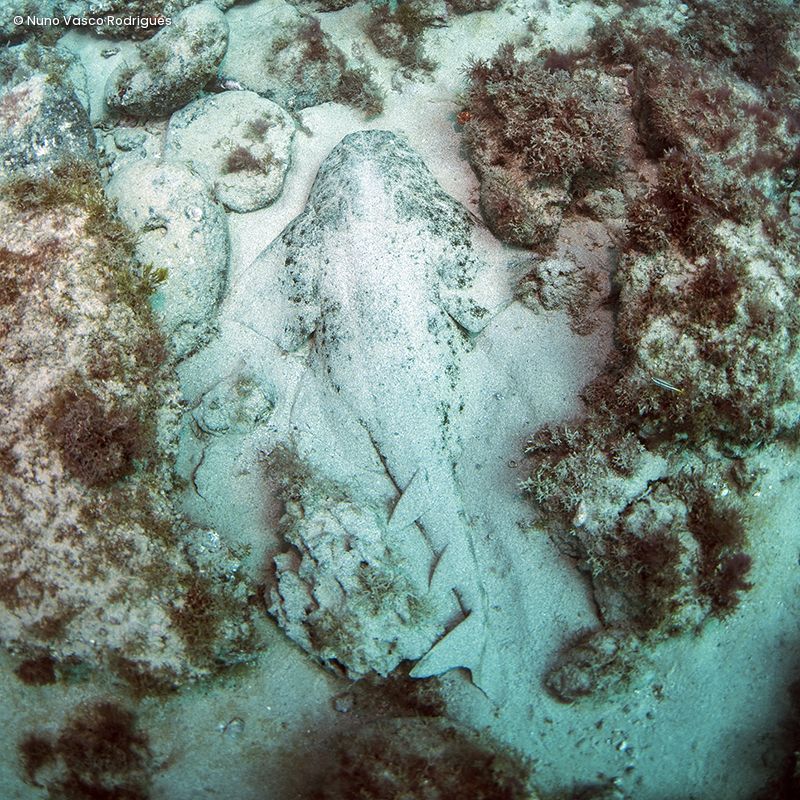
As flat as a ray, but actually a shark: angel sharks (Squatina squatina) are among the most unusual and, at the same time, most endangered marine creatures in Europe. The coastal waters of the Canary Islands are among their last major refuges and serve as a nursery for their young. But what natural dangers do young angel sharks face there? A new study by the Angel Shark Project: Canary Islands, in collaboration with the Leibniz Institute for the Analysis of Biodiversity Change (LIB), shows that even rays attack young angel sharks.
Angel sharks live on the seabed, where they often burrow into the sand and lie in wait for prey. They were once widespread in the Mediterranean and along Europe’s Atlantic coasts. Today, they are considered to be at risk of extinction – primarily due to fishing and the degradation of their habitats.
For the study, published in the journal Environmental Biology of Fishes, an international research team analysed video footage from 2020 to 2025. This footage was captured incidentally during diving and snorkelling trips off the Canary Islands and submitted via the citizen science platform Angel Shark Sighting Map. On this platform, volunteers can report sightings of angel sharks using photos or videos, which are then verified by experts. In this way, the researchers were able to document six instances in which rays attacked or attempted to prey on newborn or juvenile angel sharks.
The findings provide the first direct evidence of this previously unknown predator-prey relationship off the Canary Islands. However, it is not yet possible to deduce from the observations how often young angel sharks prey on rays, or what impact this has on their populations.
“If we are to protect endangered species effectively, we must also understand their natural interactions with other species. Our observations show that even in well-studied habitats, fundamental ecological relationships may still be unknown,” explains Eva Meyers, co-author of the study, co-founder of the Angel Shark Project and associate researcher at the LIB.
Species conservation requires an understanding of ecological interactions
The study highlights just how valuable chance observations by volunteers can be for researching previously unknown ecological interactions. The species of ray involved are themselves under threat and form part of the natural ecosystem. Their hunting behaviour is one of the natural interactions within the angel shark’s habitat.
The greatest threat to angel sharks, however, comes from humans: in particular, fishing – in which the animals are accidentally caught as by-catch in nets – and the degradation of their habitats have contributed to their drastic decline. For their long-term protection, therefore, both the reduction of human impacts and a better understanding of their ecological relationships are crucial.
Original publication:
Toledo-Padilla, H., Bañeras, T., Jacoby, D.M.P. et al. (2026): Life beneath the sand: batoid predation on neonate and juvenile angelsharks (Squatina squatina). Environmental Biology of Fishes, 109, 159.
Scientific LIB contact

Press Contact (LIB Hamburg)
