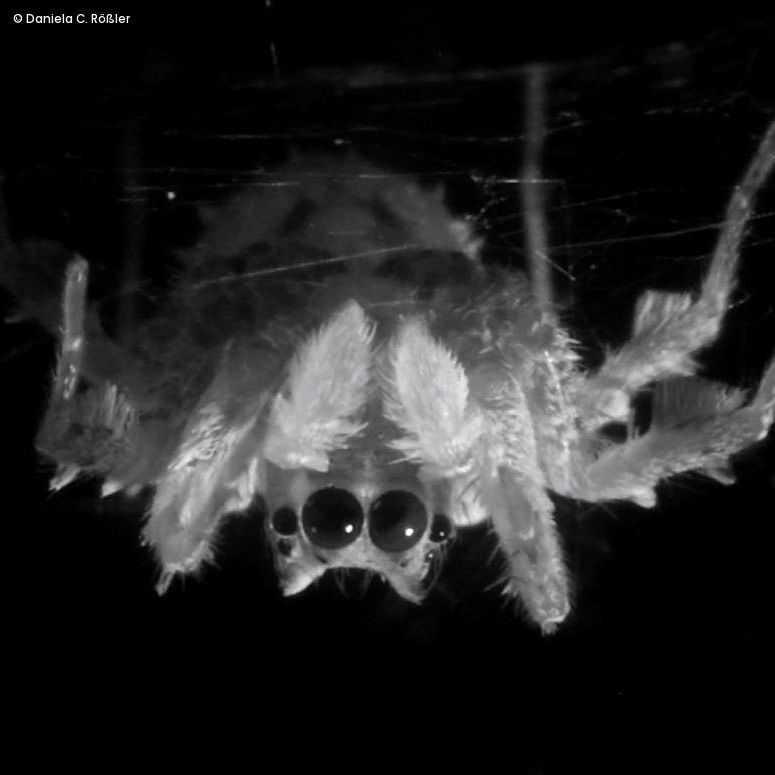
Do spiders sleep? And might they even experience a form of REM sleep similar to that seen in humans? An international research team led by the University of Bonn has investigated the sleeping behaviour of the Australian jumping spider Portia fimbriata. The results show that spiders go through different sleep phases, including a REM-like state characterised by eye movements and muscle twitches. Prof Dr Mariella Herberstein from the Leibniz Institute for the Analysis of Biodiversity Change (LIB) was part of the study. The findings were published in the journal Proceedings of the National Academy of Sciences (PNAS).
Sleep is widespread throughout the animal kingdom. However, so-called REM (Rapid Eye Movement) sleep in particular – which in humans is associated with vivid dreams – was long considered to be unique to animals with complex nervous systems. To date, REM-like sleep states have been documented in mammals, birds, reptiles and cephalopods, amongst others. The role such sleep phases play in other animal groups and how they arose in the course of evolution remains largely unclear.
A research team led by Dr Daniela Rößler and PhD student Nadja Geiger from the University of Bonn has now investigated whether spiders actually sleep and, if so, whether they go through different stages of sleep. The study focused on the Australian jumping spider Portia fimbriata, which is known for its extraordinary hunting strategies and learning abilities.
Two distinct sleep phases identified
The researchers observed the spiders over several days and nights and recorded their behaviour using high-resolution cameras. Using infrared imaging, they documented, amongst other things, typical sleeping postures, periods of rest, and eye and muscle movements.
In doing so, they identified two clearly distinguishable sleep phases. In one of these, the spiders exhibited characteristic eye movements and muscle twitches reminiscent of REM sleep in vertebrates.
But how can one tell whether a spider is actually asleep and not simply resting? To answer this question, the team investigated how quickly the animals responded to acoustic stimuli. During sleep, their reactions were significantly slowed down. If their night’s rest was disturbed, the spiders subsequently made up for the lost sleep. In doing so, they met key behavioural criteria for genuine, regulated sleep.
New questions about the evolution of sleep
It was previously assumed that complex brains require REM sleep – for example, to process information and support learning and memory processes. Spiders, however, have comparatively small brains.
“What is particularly fascinating is that a complex brain does not appear to be necessary to undergo REM-like sleep phases. Our findings therefore raise new questions about the evolutionary origins of sleep,” explains Prof Dr Mariella Herberstein from the LIB, who was involved in the research.
The new findings suggest that REM-like sleep states may not be unique to complex nervous systems. Rather, they may have emerged early in evolution and be widespread across different animal groups.
At the same time, the study highlights how important it is to investigate the behaviour of animal groups that have so far been little studied in greater detail. Careful observations can reveal surprising similarities between animals whose nervous systems differ fundamentally.
Further questions about sleep in the animal kingdom
In future studies, the researchers aim to find out how widespread REM-like sleep phases are amongst spiders and what links exist between sleep and cognitive abilities. The question of how environmental changes, in particular artificial light at night, affect the animals’ sleep will also be investigated in future.
The findings thus open up new avenues for comparative behavioural research and for understanding the evolutionary origins of sleep.
Source
Geiger, N., Capelle, M. Q., Rosentreter, P., Herberstein, M. E., Bahl, A., De Agrò, M., Klein, B. A. & Rößler, D. C. (2026): Behavioral evidence for two-stage sleep in spiders. Proceedings of the National Academy of Sciences (PNAS).


Scientific LIB contact

- Head of Centre for Taxonomy & Morphology
- Deputy Director General LIB at the Hamburg location
Phone: +49 40 238317 630
E-Mail: m.herberstein@leibniz-lib.de
Press Contact (LIB Hamburg)
